How Many Rental Properties to Make $100,000 a Year? Full Calculation, Scenarios, and Strategy
Last Updated on January 15, 2026
- 1. The Short Answer (And Why It’s Not So Simple)
- 2. Calculator: How Many Rental Properties Do You Need to Make $100,000 a Year?
- 3. How Much Capital and Portfolio Value Do You Need?
- 4. What Does “$100,000 a Year in Rentals” Really Mean?
- 5. The Core Concept: It’s All About Cash Flow Per Door
- 6. Step-by-Step: How to Calculate Cash Flow For Any Property
- 7. Calculation Scenarios: How Many Properties for $100k/Year?
- 8. Global Perspectives: US vs. UAE (Dubai) Market Comparison
- 9. Key Metrics for Property Investors: ROI, Cash Flow, and Yield Explained
- 10. Your 5-Step Strategy for Building a $100k Rental Portfolio
- 11. Tactics to Increase Cash Flow and Scale
- 12. Financing Your Investments: Mortgage and Deposit Requirements
- 13. Maximizing Passive Income: Self-Management vs. Hiring a Property Manager
- 14. How to Find the Right Investment Property: A Research Checklist
- 15. Choosing Your Rental Type: Single-Family, Multifamily, Commercial
- 16. Common Pitfalls to Avoid on Your Journey to $100k
- 17. What’s a Realistic Timeline to Earn $100k from Rentals?
- 18. Scaling Up: What Does It Take to Make $100,000 a Month?
- 19. Frequently Asked Questions (FAQ)
- 20. Ready to Start Your Real Estate Investing Journey?
- 21. Our Investment Specialists
The Short Answer (And Why It’s Not So Simple)
Earning $100,000 a year from rental properties. Sounds like the ultimate goal, right?
A six-figure passive income stream that lets you reclaim your time. For over seven years, I’ve navigated the dynamic world of real estate investing, from Dubai’s soaring towers to burgeoning international markets. I’ve seen firsthand how investors turn this dream into concrete reality.
It’s not magic.
It’s math, strategy, and a healthy dose of discipline. This isn’t just another theoretical guide. We’re going to break down the exact numbers, explore real-world scenarios, and lay out a practical strategy. Whether you’re starting with your first property or looking to scale your existing portfolio, this is your roadmap.
“Over my 7+ years in real estate, I’ve seen countless investors fixate on the number of doors. But the truth is, the number is irrelevant without understanding the engine behind it: net cash flow. A portfolio of five high-performing properties can easily outperform twenty poorly managed ones. The goal isn’t to collect properties; it’s to build a resilient income machine. That’s what we’ll focus on here—building that machine.”
To make $100,000 a year from rentals, you’ll typically need 5–20+ properties depending on your average monthly net cash flow per door. If a property nets $1,000/month, you need about 9 doors. If it nets only $400/month, you’ll need around 21 doors. And at a slim $200/month, that number jumps to about 42 doors.
The final count is driven entirely by your financing, the market you choose, and how tightly you manage your expenses. It’s not a one-size-fits-all answer. But it is a solvable equation.
Quick Capital Math: If you target a 10% cash-on-cash return, you need about $1,000,000 invested to net $100,000/year (before taxes). If you own the properties free-and-clear, at a 6% cap rate, you’d need a portfolio value of roughly $1.67M.


Calculator: How Many Rental Properties Do You Need to Make $100,000 a Year?
Stop guessing and start calculating. Use this tool to estimate how many properties you need to reach your financial goals based on your own numbers. This will give you a personalized target for your real estate investing journey.
Note: This calculator estimates pre-tax cash flow. For after-tax calculations, you must account for depreciation and your effective tax rate, as detailed in the section below.
How Much Capital and Portfolio Value Do You Need?
Beyond the number of doors, investors often ask two critical questions: “How much cash do I need to invest?” and “What should my total portfolio value be?” Here are the formulas to help you estimate.
1. Based on Cash-on-Cash (CoC) Return: This tells you how much cash you need to deploy.
- Formula:
Required Cash Investment = Target Annual Income / Target CoC Return - Example: To earn $100,000 a year with a target 10% CoC return, you need to invest $1,000,000 in cash ($100,000 / 0.10).
2. Based on Cap Rate (for a debt-free portfolio): This tells you the required value of your properties if you own them outright.
- Formula:
Required Portfolio Value = Target Annual NOI / Target Cap Rate - Example: To earn $100,000 a year (as NOI) with a portfolio that has a 6% cap rate, you need a portfolio value of $1.67 million ($100,000 / 0.06).
| Target Return | Required Cash (CoC) | Required Portfolio Value (Cap Rate, Debt-Free) |
|---|---|---|
| 8% | $1,250,000 | $1,250,000 |
| 10% | $1,000,000 | $1,000,000 |
| 6% | $1,667,000 | $1,667,000 |
What Does “$100,000 a Year in Rentals” Really Mean?
This is the most critical distinction for new property investors. The target of $100,000 should always mean net cash flow after all operating expenses and debt service are paid.
It’s not your gross rental income.
Gross rent is a vanity metric; net cash flow is sanity. This is the actual, spendable passive income you can use to pay your bills, reinvest, or quit your job. Here’s the breakdown: Gross rental income minus all your operating expenses equals Net Operating Income (NOI). Then, NOI minus your mortgage payments (principal and interest) equals your final net cash flow.
Understanding this flow is non-negotiable. NOI is a pre-debt metric used to value properties, while cash flow is what the investor actually pockets.
After-Tax Cash Flow (An Important Clarification)
This article primarily discusses pre-tax net cash flow. To calculate your after-tax cash flow, you must subtract taxes owed on your rental income. A key advantage for real estate investors is depreciation, a non-cash deduction that can significantly reduce your taxable income.
- Simplified Formula:
Taxable Income ≈ NOI - Mortgage Interest - Depreciation Taxes Owed = Taxable Income × Your Effective Tax RateAfter-Tax Cash Flow = Pre-Tax Cash Flow - Taxes Owed
Consult a tax professional to understand how depreciation and other deductions apply to your specific situation. For official guidance, refer to resources like the IRS Publication 527, Residential Rental Property, available at irs.gov.
The Core Concept: It’s All About Cash Flow Per Door
Forget the number of properties for a moment. The single most important metric is your net cash flow per door. This is the profit each of your rental units generates every month.
Let’s define the terms clearly:
- Gross Rent: The total rent you collect from tenants.
- Operating Expenses (OpEx): All the costs to run the property except the mortgage. This includes property taxes, insurance, maintenance, repairs, property management fees, HOA dues, utilities (if you pay them), and reserves for vacancy and future big-ticket items (CapEx).
- Net Operating Income (NOI): Gross Rent – Operating Expenses.
- Net Cash Flow: NOI – Debt Service (your mortgage payment).
The Golden Formula to Calculate Your Number
With that understood, the formula becomes incredibly simple and powerful.
Formula:
Number of Properties = Target Annual Income / Average Annual Net Cash Flow Per PropertyExample:
21 Properties = $100,000 / $4,800(with average net income of $400/month per property)
Step-by-Step: How to Calculate Cash Flow For Any Property
Here’s how you underwrite any potential investment property to find its true cash flow. No shortcuts.
- Step 1: Estimate Gross Rental Income. Don’t just guess. Use tools like Zillow, Rentometer, and look at active comparable listings in the area. Account for seasonality if you’re in a market with fluctuating demand.
- Step 2: Calculate ALL Operating Expenses. This is where most investors fail. Be brutally realistic. Include property taxes, insurance, a budget for maintenance and repairs, a reserve for capital expenditures (CapEx like a new roof), HOA fees, property management fees (even if you self-manage, budget for it!), any utilities you’ll cover, and a vacancy allowance. Vacancy rates vary by market, so use local data for accuracy.
- Step 3: Factor in Your Mortgage. Your debt service is determined by your loan’s interest rate, term, and amortization schedule. For investment properties, a down payment of less than 20% is rare, and Private Mortgage Insurance (PMI) is typically not available.
- Step 4: Calculate Net Cash Flow. The simple math:
Net Cash Flow = Gross Rent – All Expenses – Mortgage Payment. - Step 5: Annualize and Apply the Golden Formula. Multiply your monthly net cash flow by 12 to get your annual figure, then plug it into the formula from the previous section.
Quick Screens for Fast Analysis: The 1% and 50% Rules
While full underwriting is essential, these rules of thumb can help you quickly filter deals:
- The 1% Rule: A property’s monthly rent should be at least 1% of its purchase price. A $200,000 property should ideally rent for $2,000/month or more. This is a quick screening tool, not a substitute for analysis, and is often difficult to achieve in high-appreciation markets.
- The 50% Rule: This suggests that operating expenses (excluding the mortgage) will be about 50% of your gross rental income. If a property rents for $2,000/month, budget around $1,000 for OpEx. This helps in making a preliminary estimate of NOI.
Pro-Forma Case Study: Underwriting a Deal in Cleveland, OH
Let’s apply this to a real-world example from a high-cash-flow market.
| Metric | Value | Calculation |
|---|---|---|
| Purchase Price | $250,000 | Market analysis |
| Down Payment (20%) | $50,000 | 20% of Price |
| Loan Amount | $200,000 | Price – Down Payment |
| Interest Rate / Term | 7% / 30 years | Current market rates |
| Monthly Mortgage (P&I) | $1,331 | Loan calculation |
| Monthly Gross Rent | $2,100 | Market comps |
| Monthly Operating Expenses | ||
| – Property Taxes (1.8%) | $375 | ($250,000 * 0.018) / 12 |
| – Insurance | $120 | Quote |
| – Vacancy (5%) | $105 | $2,100 * 0.05 |
| – Repairs & Maintenance (8%) | $168 | $2,100 * 0.08 |
| – CapEx Reserve (8%) | $168 | $2,100 * 0.08 |
| – Property Management (8%) | $168 | $2,100 * 0.08 |
| Total Monthly OpEx | $1,104 | Sum of expenses |
| Monthly Net Cash Flow | -$335 | $2,100 – $1,104 – $1,331 |
| Annual Net Cash Flow | -$4,020 | -$335 * 12 |
| Doors Needed for $100k | 28 | $100,000 / ($300 * 12) |
Note: This example demonstrates how a seemingly good deal can turn negative with realistic expense calculations. To make this deal work, you’d need to find a lower purchase price, achieve higher rent, or secure better financing.
Breakdown of Income vs. Expenses for a Typical Rental Property
Your gross rent isn’t what you keep. It’s just the starting point. A large portion gets eaten up by expenses. Here’s a typical breakdown and how to optimize each slice of the pie.
| Expense Type | Typical % of Gross Rent | How to Reduce |
|---|---|---|
| Mortgage (P&I) | 30-50% | Increase down payment, secure a lower interest rate, choose a longer loan term. |
| Property Taxes | 10-15% | Appeal your property tax assessment if it’s unfairly high. |
| Insurance | 3-5% | Shop around for policies annually, bundle with other insurance. |
| Maintenance & Repairs | 5-10% | Implement a preventive maintenance schedule, use durable materials. |
| CapEx Reserves | 5-10% | Essential for big items (roof, HVAC). Don’t skip this. |
| Property Management | 8-10% | Negotiate fees for a larger portfolio, or self-manage if you have the systems. |
| Vacancy | 5-8% | Rigorous tenant screening to find long-term tenants, offer renewal incentives. |
| HOA/Utilities | 2-5% | (If applicable) Look for properties with low HOA fees or pass utility costs to tenants. |
Note: These percentages are general benchmarks and can vary significantly by market.
Calculation Scenarios: How Many Properties for $100k/Year?
Let’s run the numbers. Your required door count swings dramatically with the cash flow per property. It all comes down to your investment strategy and market selection.
Scenario 1: High Cash Flow ($1,000/month per door)
This is often found in markets with strong rent-to-price ratios or through strategies like house-hacking a multifamily property.
Calculation: $100,000 / ($1,000 × 12) = 8.33 → 9 properties.
Scenario 2: Average Cash Flow ($400/month per door)
This is a very common and achievable target for many investors in balanced markets, especially with traditional financing.
Calculation: $100,000 / ($400 × 12) = 20.83 → 21 properties.
Scenario 3: Low Cash Flow / High Appreciation ($200/month per door)
Investors in expensive coastal markets might accept lower cash flow in exchange for the potential of significant capital growth.
Calculation: $100,000 / ($200 × 12) = 41.67 → 42 properties.
| Cash Flow/Month | Annual Cash Flow/Door | Properties Needed for $100k/Year |
|---|---|---|
| $1,000 | $12,000 | 9 |
| $400 | $4,800 | 21 |
| $200 | $2,400 | 42 |
Global Perspectives: US vs. UAE (Dubai) Market Comparison
For international investors, the “right” market dramatically changes the math. Here’s a high-level comparison between a typical US market and Dubai.
| Feature | United States (e.g., Midwest) | UAE (Dubai) |
|---|---|---|
| Typical Gross Yield | 6-9% | 7-10% (Long-term), 10-15%+ (Short-term) |
| Income Tax | Federal & State income tax apply. | 0% personal income tax on rental returns. |
| Key Expenses | Property Tax (1-2.5%), Insurance, Maintenance, HOA. | Service Charges (can be high), DEWA (utilities), Maintenance. No property tax. |
| Financing (Non-Resident) | Possible but often requires higher down payments (25%+) and rates. DSCR loans are common. | Available, typically up to 50-75% LTV. Stricter criteria for non-residents. |
| Regulation | Varies by state (some landlord-friendly, some tenant-friendly). | Regulated by RERA. Generally pro-business and landlord-friendly. |
| Key Strategy | Balanced cash flow and appreciation. BRRRR is popular. | High cash flow from short-term rentals (holiday homes), capital appreciation. |
If you’re considering investing in Dubai apartments, understanding these market differences is crucial for your strategy.
Key Metrics for Property Investors: ROI, Cash Flow, and Yield Explained
To compare different deals and track your portfolio’s health, you need to speak the language of real estate investing. These four core metrics will help you evaluate any investment property like a pro.
| Metric | Formula | What It Shows |
|---|---|---|
| Net Cash Flow | Annual Rent - Annual Expenses - Annual Debt Service |
The actual profit you pocket each year. The ultimate measure of a rental’s performance. |
| Gross Rental Yield | (Annual Gross Rent / Purchase Price) * 100 |
A quick, high-level look at a property’s income potential relative to its cost. Learn more about Gross Rental Yield. |
| Cap Rate | (Net Operating Income / Purchase Price) * 100 |
The unlevered return on the property. Crucial for comparing properties regardless of financing. |
| ROI (Cash-on-Cash Return) | (Annual Net Cash Flow / Total Cash Invested) * 100 |
The return you’re earning on the actual money you have in the deal. This is crucial for leveraged investors. |
| Capital Growth | ((Current Value - Purchase Price) / Purchase Price) * 100 |
The appreciation of the asset over time. This is how wealth is built long-term. |
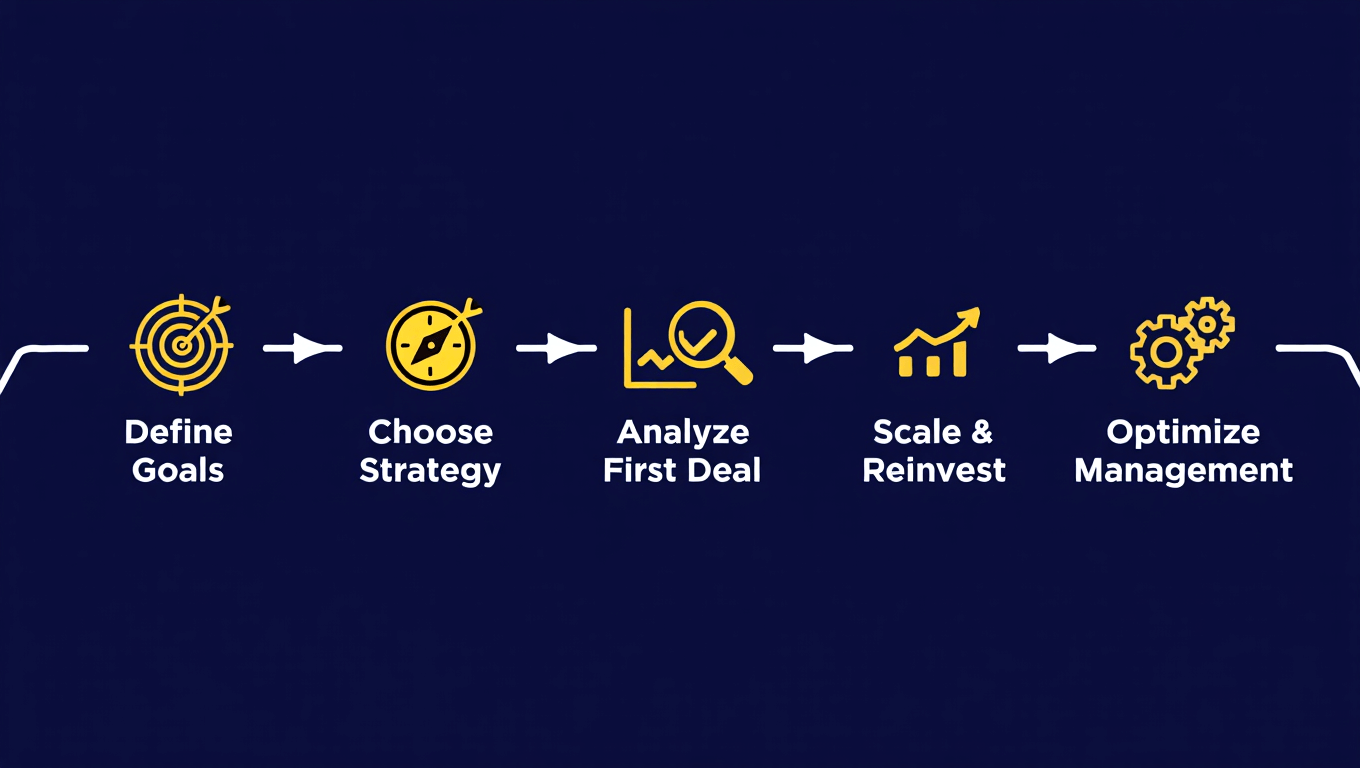
Your 5-Step Strategy for Building a $100k Rental Portfolio
Achieving a $100k rental income doesn’t happen by accident. It requires a clear, repeatable system.
- Define Your Financial Goals and Timeline: What is your target passive income? What’s your risk tolerance? How much time can you commit? Your answers will shape your entire investment strategy.
- Choose Your Strategy: Will you pursue a traditional buy-to-let strategy, the BRRRR method, or focus on small multifamily properties? Align your choice with your available capital and financing options.
- Find and Analyze Your First Deal: Learn to screen deals quickly (using tools like the 1% rule) and then underwrite them thoroughly. Always verify market rent with real-time comps and stress-test your numbers against higher interest rates or vacancy.
- Scale and Reinvest: Use the cash flow from your first properties to “snowball” into the next. In the US, you can use tools like a 1031 exchange to defer capital gains taxes and scale faster. A 1031 exchange requires you to identify a replacement property within 45 days and close within 180 days. The property must be “held for investment,” a term without a fixed minimum holding period, but a common practice is 1-2 years. Refinance strategically to pull out equity, but never overleverage to the point of negative cash flow. Disclaimer: This information is for general educational purposes and does not constitute tax or legal advice. Consult with a qualified professional regarding 1031 exchanges.
- Optimize Management: Create standard operating procedures (SOPs) for everything: tenant screening, maintenance requests, rent collection, and reporting. As you scale, hiring a professional property manager can be the key to buying back your time and achieving true passive income.
“A disciplined strategy is everything. Many investors get distracted by ‘hot’ markets or complex deals. The most successful ones I work with are those who define their criteria, stick to their underwriting, and execute consistently. They treat it like a business, not a hobby.”

Tactics to Increase Cash Flow and Scale
Increase Cash Flow Per Property
- Value-Add Improvements: Simple cosmetic rehabs, adding a bedroom, installing in-unit laundry, or adding amenities like dedicated parking or storage can justify higher rents.
- Revenue Management: Don’t set and forget your rents. Adjust them to market rates at renewal. Implement pet rent or other ancillary income streams.
- Expense Control: Proactively appeal property taxes, re-bid your insurance annually, and focus on preventive maintenance to avoid costly emergency repairs.
Smart Financing and Refinancing (BRRRR Method)
The BRRRR (Buy, Rehab, Rent, Refinance, Repeat) method is a powerful way to scale. You buy a distressed property, use a rehab loan to force equity, rent it out, and then do a cash-out refinance to pull your initial capital back out. This allows you to recycle the same down payment over and over.
The key is to ensure the property still cash flows positively after the refinance.
Choosing the Right Markets
Look for markets with strong fundamentals: job growth, population growth, landlord-friendly laws, and a healthy balance between property prices and market rents. For those exploring international opportunities, consider top areas to invest in Dubai real estate.
Financing Your Investments: Mortgage and Deposit Requirements
For an investment property, you can’t use the same low-down-payment loans as for a primary home. Expect to put down 15-25% or more. A higher down payment reduces your monthly mortgage, which directly increases your net cash flow.
It also makes your offer stronger and can help you secure a better interest rate. Don’t forget to budget for closing costs (typically 2-5% of the purchase price) and have cash reserves on hand (often 3-6 months of PITI per property).
Disclaimer: This information is for general educational purposes and does not constitute financial advice. Consult with a qualified mortgage professional.
| Loan Type | Typical Down Payment | Key Feature | Pros | Cons |
|---|---|---|---|---|
| Conventional | 15-25% | Standard loan from banks. | Widely available, competitive rates. | Strict DTI and credit requirements. |
| DSCR Loan | 20-25% | Qualifies based on property’s cash flow, not personal income. | Great for self-employed investors. | Higher interest rates and fees. |
| FHA (House Hack) | 3.5% | For owner-occupied 2-4 unit properties. | Very low down payment. | Must live in one unit for at least a year. |
| VA (House Hack) | 0% | For eligible veterans on owner-occupied 2-4 unit properties. | No down payment required. | Eligibility is restricted to veterans. |
Note: For investment properties, PMI is often unavailable. Lenders like Fannie Mae and Freddie Mac have specific guidelines for investment loans, which you can review at fanniemae.com.
Maximizing Passive Income: Self-Management vs. Hiring a Property Manager
This is a classic dilemma for property investors. Do you save money by doing it yourself or save time by hiring a pro?
- Self-management: You save the 8-10% management fee, giving you maximum cash flow and total control. The downside is the time commitment and stress. You’re the one getting the 2 a.m. call about a broken pipe.
- Hiring a Property Manager: You pay a fee, but you get your time back. A good property manager handles tenant screening, rent collection, maintenance coordination, and legal compliance. This is the path to truly passive income.
The decision often depends on your distance from the property, the number of units you own, and your personal desire for passivity.
| Criterion | Self-Manage | Property Manager |
|---|---|---|
| Time Cost | High | Low |
| Financial Cost | 0% fee (but your time has value) | 8-12% of gross rent |
| Control | Total | Low (you set the strategy) |
| Stress Factor | High | Low |
| Expertise | You must be the expert | Leverages their network & experience |
| Best For | Local, hands-on investors with 1-4 units | Remote investors, large portfolios, those seeking passive income |
How to Find the Right Investment Property: A Research Checklist
Finding a profitable deal is about systematic research, not luck. Use this checklist to analyze any potential investment.
- Location Analysis: Is the neighborhood safe? Are there good schools, jobs, and transit options? Check population and job growth trends.
- Rental Demand: What are the local vacancy rates? How long do rentals sit on the market? Is demand stable year-round?
- Property Type: Does a single-family home, duplex, or small multifamily building best fit your budget and management capacity?
- Physical Condition: How old are the major systems (roof, HVAC, plumbing, electrical)? Budget for any deferred maintenance or upcoming CapEx.
- Price and Valuation: Does the purchase price align with recent comparable sales? What is the market cap rate? Does the deal still work if rents dip or expenses rise?
- Growth Potential: Are there any major infrastructure projects or new employers coming to the area that could boost future values and rents?
Choosing Your Rental Type: Single-Family, Multifamily, Commercial
The type of property you buy has a huge impact on your path to $100k.
- Single-Family Homes (SFH): Pros include high-quality tenants who often stay longer and simpler management. The main con is that when it’s vacant, your income for that property is 100% gone.
- Small Multifamily (2-4 units): The biggest pro is scale. You get multiple income streams under one roof, which provides a buffer against vacancy. If one unit is empty, you still have income from the others. Cons include more complex management and potentially higher tenant turnover.
- Commercial/5+ units: This is a different league. Valuations are based on NOI, not comps, which can be an advantage. However, financing is more complex, and management is a full-time job, almost always requiring a professional team.
An Important Distinction: Long-Term vs. Short-Term Rentals (STR)
The rise of platforms like Airbnb has made short-term rentals a popular strategy, especially in tourist hubs like Dubai. If you’re exploring this avenue, check out the lucrative world of short-term rentals in Dubai.
| Feature | Long-Term Rental (LTR) | Short-Term Rental (STR) / Holiday Home |
|---|---|---|
| Income Potential | Stable, predictable monthly income. | Higher potential income, but volatile and seasonal. |
| Vacancy | Lower risk; tenants sign 12+ month leases. | Higher risk; depends on tourism, seasons, and marketing. |
| Management | Less intensive; periodic check-ins. | Very intensive; requires daily management, cleaning, guest communication. |
| Expenses | Standard OpEx. | Higher costs: platform fees, frequent cleaning, utilities, marketing. |
| Regulation | Standard landlord-tenant laws. | Often heavily regulated with special licenses, taxes (e.g., tourism fees in Dubai). |
| Property Type | Pros | Cons | Cash Flow Profile | Management Complexity |
|---|---|---|---|---|
| Single-Family (SFH) | Quality tenants, high liquidity | 100% vacancy risk, scales slower | Moderate | Low |
| Small Multifamily (2-4) | Scales faster, vacancy buffer | Tenant concentration, higher entry cost | High | Medium |
| Commercial (5+) | Valued on income, economies of scale | Complex financing, high management needs | Very High | High |
Common Pitfalls to Avoid on Your Journey to $100k
I’ve seen these mistakes derail more investors than anything else. Avoid them at all costs.
- Overleveraging: Taking on too much debt without enough cash reserves. A few months of vacancy can wipe you out.
- Miscalculating Expenses: The “oops” factor. Forgetting to budget for CapEx, vacancy, and repairs is the fastest way to turn a profitable deal into a money pit.
- Weak Tenant Screening: A bad tenant can cost you tens of thousands in lost rent, legal fees, and damages. Your screening process is your first line of defense.
- Analysis Paralysis: Spending years “learning” but never buying a property. Your first deal won’t be perfect. The key is to start with a small, safe deal and learn by doing.
For more guidance on avoiding common mistakes, explore top investment mistakes to avoid in Dubai’s real estate market.
What’s a Realistic Timeline to Earn $100k from Rentals?
The timeline depends entirely on your strategy, starting capital, and intensity. These are not guarantees but common paths investors follow.
- The Slow and Steady Path (Aiming for 10–15 years): This involves using conservative leverage, buying one property every 1-2 years, and letting cash flow and appreciation compound over time. It’s a lower-stress, highly effective path to wealth.
- The Accelerated Path (Aiming for 5–7 years): This requires a more aggressive approach. You might use the BRRRR method to recycle capital, focus on high-cash-flow markets, and take on a more active role in finding and managing deals. It’s more work, but it can drastically shorten your timeline.
Key factors that influence your speed include your savings rate, market selection, ability to find good deals, and your discipline in reinvesting your profits. If you’re considering long-term investments in Dubai, understanding these timelines is essential.
Scaling Up: What Does It Take to Make $100,000 a Month?
Just for perspective, let’s look at what it takes to hit the next level: $100,000 a month, or $1.2 million a year. The formula is the same, but the scale is vastly different.
- If you average $1,000/month net per door → you need 100 doors.
- If you average $400/month net per door → you need 250 doors.
- If you average $200/month net per door → you need 500 doors.
At this scale, the challenges multiply. You’re no longer just an investor; you’re running a large business. The biggest hurdles become securing capital, building a robust management infrastructure (with layers of staff), and managing portfolio-level risk.
“Going from 10 doors to 100 is not a linear jump. The systems that work for a small portfolio break down completely. At that level, your success depends less on finding the next deal and more on building the right team and scalable processes. It’s a CEO mindset.”
| Net Cash Flow/Door | Doors Needed for $100k/Month | Operational Complexity |
|---|---|---|
| $1,000 | 100 | Requires a professional management company, dedicated asset manager, and strong lender relationships. |
| $400 | 250 | Full-scale real estate operation with in-house staff for management, leasing, and maintenance. |
| $200 | 500 | Institutional-level operations, likely involving multiple markets and asset classes. |
Frequently Asked Questions (FAQ)
Is $100,000 a year from rentals a realistic goal?
Absolutely. It’s a challenging but very realistic goal. Based on industry data and investor experiences, a 5-15 year timeframe is a common target, depending on the strategy and starting capital.
How much starting capital is needed to generate $100k from rentals?
This varies wildly. You could start with a low-down-payment FHA loan ($10k-$20k) and house-hack your way up. More realistically, having $100,000–$250,000 in liquid capital provides a strong foundation to acquire several properties and build momentum.
What is the average ROI for rental properties?
There is no single “average.” Cash-on-cash ROI can range from 5% in high-appreciation markets to over 20% for a successful BRRRR deal, depending on the strategy. A common target for a sustainable buy-and-hold property is often in the 8-12% range. For insights on Dubai’s market, see best ROI properties in Dubai.
Which factors influence profitability most?
The three biggest factors are: 1) The price you pay for the property, 2) Your financing terms (interest rate and down payment), and 3) How effectively you control your operating expenses.
Are certain property types more profitable?
Generally, small multifamily properties (2-4 units) often offer a higher cash flow potential per dollar invested than single-family homes due to economies of scale (e.g., one roof, one transaction for multiple income streams). However, they also come with more management complexity.
With $100k to invest, is it better to buy one property or multiple?
It depends on the market. In an expensive market, $100k might only be enough for a down payment on one property. In a more affordable market, you might be able to buy two or three properties. Diversifying across multiple properties reduces your risk if one of them has an extended vacancy.
How much portfolio value do I need to net $100k (free and clear)?
It depends on your portfolio’s average Cap Rate. At a 6% cap rate, you would need a portfolio valued at approximately $1.67 million. At an 8% cap rate, you would need about $1.25 million.
Ready to Start Your Real Estate Investing Journey?
With the right strategy, disciplined underwriting, and robust systems, achieving a $100,000/year income from rental properties is an attainable goal. The journey begins with a single step: understanding your numbers.
Run your scenarios in the calculator, define your personal investment strategy, and talk to a lender to secure pre-approval. Your path to financial freedom through real estate starts now.
Whether you’re looking at apartments in Dubai or exploring villas in Dubai, the principles remain the same: know your numbers, manage your expenses, and build a resilient portfolio.

Our Investment Specialists

Laura Lavinsky
Realtor

Mike Griffin
Realtor

Zoe Hernandez
Realtor