Escape the Off-Plan Trap: Your Strategic Guide to Pre-Completion Property Sales in Dubai
Last Updated on December 24, 2025

Understanding the Developer Payment Threshold System
Thousands of property investors across Dubai find themselves caught in what feels like a financial maze – they’ve committed substantial capital to off-plan developments, market conditions have shifted dramatically, and now they desperately need liquidity but discover that selling unfinished property involves a labyrinth of developer approvals, legal requirements, and regulatory procedures that seem designed to keep investors locked in. The frustration multiplies when investors realize their circumstances have changed – perhaps a job relocation demands immediate funds, new investment opportunities have emerged, or the original 4-bedroom apartments in Dubai they purchased no longer align with their family needs – yet the standard advice about property sales completely fails to address the unique challenges of off-plan transactions in Dubai’s complex market.
The core obstacle facing off-plan property owners stems from Dubai’s sophisticated regulatory framework designed to prevent speculative flipping while protecting legitimate investment interests. Most Dubai developers impose minimum payment thresholds, typically ranging from 30% to 50% of total property value, before permitting resale transactions. This requirement isn’t arbitrary – it represents a calculated balance between preventing market manipulation and allowing genuine property investors to adapt to changing circumstances.
Emaar Properties, Dubai’s largest developer, requires 40% payment completion before issuing No Objection Certificates for off-plan property resales. This policy affects thousands of investors in Downtown Dubai, Dubai Hills Estate, and Emirates Living communities. DAMAC Properties applies a 35% threshold for Dubai Marina and Business Bay property projects, while Nakheel demands 45% completion for Palm Jumeirah developments. Understanding these variations becomes crucial when planning exit strategies for any Dubai property investment.
The payment verification process involves comprehensive audit procedures where developers examine all historical payments, including initial deposits, milestone payments, and any penalty settlements. Dubai Land Department statistics from 2024 indicate that approximately 67% of off-plan property resale applications initially fail developer payment audits due to incomplete documentation or outstanding service charges. These rejections create delays averaging 21 days while investors scramble to resolve payment discrepancies for their Dubai property.
Dubai International Financial Centre regulations add another layer of complexity for property within DIFC boundaries. These developments often require additional compliance certifications and international banking documentation that can extend approval timelines by 15-30 days beyond standard Dubai property procedures.
Early settlement options provide strategic alternatives for investors falling short of payment thresholds. Many Dubai developers offer settlement discounts of 2-5% for advance payments, effectively allowing investors to reach minimum thresholds while capturing cost savings. Emirates NBD’s real estate financing division reports that 34% of off-plan property investors choose early settlement specifically to enable resale transactions, viewing the settlement discounts as worthwhile investments in transaction flexibility for their Dubai property portfolios.
The No Objection Certificate (NOC) Acquisition Process
NOC procurement represents the most critical step in off-plan property sales, yet many investors underestimate the complexity and time requirements involved. This document serves multiple purposes beyond simple resale approval – it confirms payment status, verifies compliance with developer terms, and establishes legal transfer authority for new buyers of Dubai property.
The NOC application process begins with comprehensive financial reconciliation between investors and Dubai developers. This involves reviewing all payment records, service charge obligations, and any modification agreements executed during the construction period. Developers typically require 10-15 business days for this reconciliation, though complex cases involving payment plan modifications or penalty settlements can extend review periods significantly for Dubai property transactions.
Documentation requirements for NOC applications include original Sale and Purchase Agreements, complete payment histories, Emirates ID copies, and bank transfer confirmations. International investors must provide additional attestation documentation from their home countries, creating potential delays if documents aren’t properly prepared in advance. The UAE Embassy attestation process alone can consume 7-10 days for investors residing abroad who own Dubai property.
Processing fees for NOC certificates vary significantly between developers and property types. Standard residential property projects typically incur fees ranging from AED 3,000 to AED 8,000, while luxury developments and commercial property command higher fees up to AED 15,000. These fees aren’t refundable, even if subsequent resale transactions fail to complete, making careful buyer qualification essential before NOC procurement for any Dubai property.
Sobha Realty has introduced expedited NOC processing for investors meeting specific criteria, reducing standard processing times from 15 days to 5 days for an additional fee of AED 2,500. This service targets property investors with clean payment histories and straightforward resale scenarios, offering valuable time savings for time-sensitive Dubai property transactions.
Strategic Pricing and Market Positioning

Successfully pricing off-plan property requires understanding the complex relationship between completion risk, market appreciation, and buyer psychology. Off-plan property typically trades at 10-20% discounts compared to equivalent completed units, reflecting the uncertainty and waiting period buyers must accept in Dubai’s dynamic property market.
Market research from Property Monitor indicates that off-plan property in prime locations like Downtown Dubai and Dubai Marina have appreciated 23% on average from launch to completion over the past three years. However, this appreciation varies dramatically by developer reputation, project completion timeline, and market conditions during the construction period for Dubai property developments.
| Developer Tier | Typical Discount | Market Risk | Buyer Pool |
| Premium (Emaar, Nakheel) | 10-15% | Low | International investors |
| Established (DAMAC, Sobha) | 15-20% | Medium | Regional investors |
| Emerging developers | 20-30% | High | Local speculators |
Pricing strategies must account for the assumption of payment responsibilities by new buyers. Unlike completed property sales where buyers arrange independent financing, off-plan resales typically involve buyers assuming existing payment schedules. This creates unique value propositions where below-market pricing can be offset by favorable payment terms inherited from original purchase agreements for Dubai property.
Competitive analysis becomes particularly important in developments with multiple similar units available for resale. Downtown Dubai currently has over 400 off-plan property units listed for resale across various projects, creating intense competition that rewards strategic pricing and marketing approaches. Property priced within 5% of comparable listings typically achieve sales within 45-60 days, while premium pricing can extend marketing periods to 120+ days in Dubai’s competitive property market.
Regulatory Compliance and Transfer Procedures
Dubai Land Department’s off-plan property transfer procedures have evolved significantly, incorporating digital platforms and streamlined processes that reduce transaction completion times while maintaining regulatory oversight. The Dubai REST app now handles most off-plan property transfers, eliminating the need for physical visits to DLD offices in many cases.
Transfer fee structures for off-plan property differ from completed property transactions. Both buyers and sellers pay 2% of transaction value to DLD, plus additional fees ranging from AED 2,000 to AED 4,000 depending on property value thresholds. Property valued above AED 500,000 incur the higher fee structure, affecting most premium developments in Dubai.
The digital transfer process requires precise documentation uploaded through secure platforms. Document rejection rates have decreased from 23% in 2023 to 11% in 2024 as property investors have adapted to digital requirements and improved document preparation. Common rejection reasons include inconsistent name spellings, expired identification documents, and incomplete payment verifications for Dubai property transactions.
Timing coordination between NOC approval and DLD registration becomes crucial for transaction success. NOC certificates remain valid for 90 days from issuance, creating deadline pressure for completing transfers. Experienced property investors often begin buyer qualification and documentation preparation before NOC procurement to maximize available transaction windows for their Dubai property sales.
International Investor Considerations
Foreign investors face additional complexities when selling off-plan property, particularly regarding tax implications, currency transfers, and legal representation requirements. US investors must consider potential capital gains implications, while UK investors navigate post-Brexit banking relationships that can affect international transfers for Dubai property investments.
Currency hedging strategies become particularly relevant for investors who originally purchased Dubai property in foreign currencies but now face AED-denominated sale proceeds. Exchange rate fluctuations can significantly impact net proceeds, especially for large transactions involving premium property. HSBC UAE reports that 43% of international off-plan property investors utilize currency hedging instruments to protect against exchange rate risks during extended sale processes in Dubai.
Power of Attorney arrangements remain essential for international investors unable to travel to Dubai for transaction completion. These documents must be properly attested through UAE Embassy procedures in investors’ home countries, a process that can take 2-4 weeks depending on embassy processing times and document complexity for Dubai property transactions.
Profit Maximization Through Strategic Timing
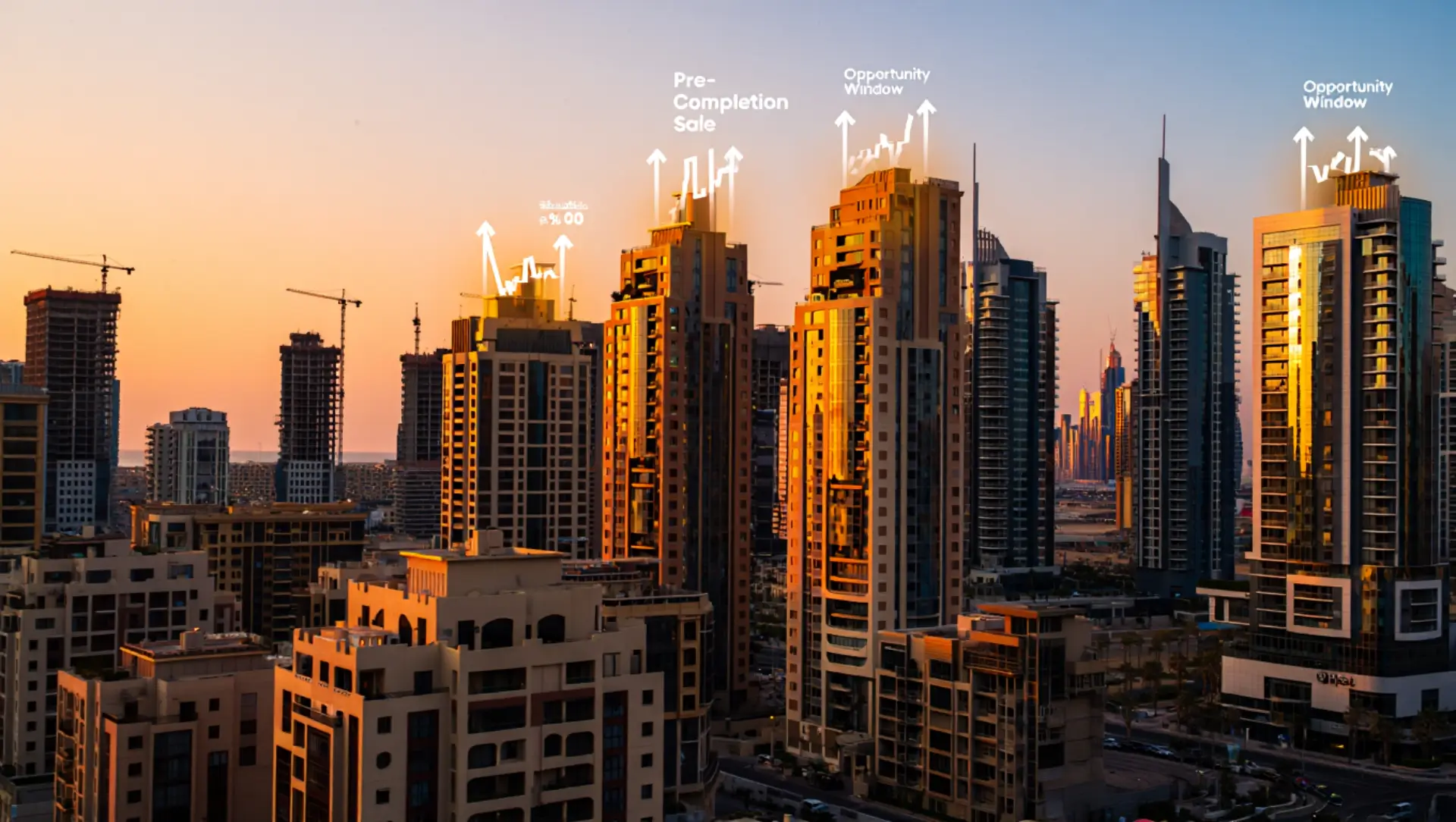
Market timing significantly impacts off-plan property sale outcomes, with certain periods offering superior pricing conditions and buyer activity levels. Q4 traditionally provides optimal selling conditions as year-end bonuses increase buyer purchasing power while tax considerations motivate transactions before calendar year-end for Dubai property investments.
Construction milestone timing also affects property values and buyer appeal. Property nearing completion command premium pricing as completion risk diminishes, while early-stage projects offer higher discounts but face uncertain market conditions. Property within 6-12 months of completion typically achieve optimal balance between pricing and risk factors in Dubai’s property market.
Ramadan periods create unique timing considerations as reduced business activity can extend transaction timelines but may also reduce competitive listing pressure. Savvy property investors often use these periods for preparation activities like documentation gathering and NOC procurement, positioning for active marketing when business activity resumes in Dubai.
The strategic advantage of off-plan property sales lies in their ability to capture market appreciation while providing capital liquidity years before completion. Investors who purchased Downtown Dubai property at launch in 2022 for AED 2.8 million can now resell for AED 3.4 million, achieving 21% returns while transferring completion risk to new buyers in Dubai’s thriving property market.
Success in off-plan property sales demands careful preparation, strategic timing, and professional guidance through complex regulatory requirements. Property investors who approach these transactions systematically, understanding developer requirements and Dubai market dynamics, consistently achieve superior outcomes compared to those attempting rushed or poorly planned sales.
With proper guidance from experienced professionals like Anika Property, off-plan property owners can navigate these complex procedures confidently, transforming what initially appears as a challenging situation into a profitable opportunity that provides both immediate liquidity and long-term investment flexibility in Dubai’s dynamic property landscape.