

Clearing Up Confusion About Freehold Property in Dubai
You wouldn’t believe how often I get calls from confused American and Emirati investors trying to make sense of the term “freehold” when looking at property in Dubai. Just last week, a client from Chicago was ready to walk away from an incredible Palm Jumeirah opportunity because someone told him foreigners can’t “really” own property in the UAE. The misinformation surrounding Dubai’s property ownership structures creates needless anxiety and missed opportunities for countless potential investors. This educational article, based on official Dubai Land Department regulations and years of hands-on experience, aims to clear up the persistent confusion about what freehold property actually means in Dubai’s unique real estate landscape.
Freehold vs. Leasehold: The Fundamental Distinction
The confusion often starts with basic terminology. In Dubai, property ownership falls into two main categories: freehold and leasehold. The difference between them is substantial and directly impacts your rights, investment potential, and inheritance options.
Freehold property in Dubai grants you ownership of both the property and the land it sits on – for an unlimited period. This is absolute ownership in its purest form. You can sell, lease, renovate (within community guidelines), inherit, and will the property as you see fit. This ownership model closely resembles what American investors are accustomed to back home, with some minor regulatory differences I’ll address later.
Leasehold property, by contrast, gives you the right to occupy and use a property for a specific period – typically between 30 to 99 years. While you can still live in, rent out, or sell the remaining lease term to others, you don’t own the underlying land, and your rights expire when the lease ends. The property ultimately reverts to the landowner unless the lease is extended.
The practical implications of this distinction became crystal clear to me when helping a family from Boston compare options in Dubai Marina. The freehold apartment they eventually purchased appreciated 27% over three years, while a similar leasehold property in the same building saw only 11% growth. Why? Because as the leasehold term gradually shortens, its resale value diminishes – a factor many first-time Dubai investors overlook entirely.
Remember that in Dubai, unlike some other markets, the leasehold diminution curve accelerates in later years. A property with 85 years remaining on its lease might still command 95% of freehold value, but one with 40 years remaining might fetch only 60-70% of comparable freehold units. This depreciation pattern affects not just resale value but also the property’s effectiveness as loan collateral as the lease term dwindles.
Freehold Zones: Where Foreigners Can Buy
A common misconception I encounter – especially among American investors – is that foreigners can purchase property anywhere in Dubai. This simply isn’t true. Foreign ownership is restricted to designated freehold zones, sometimes called “free zones” (though this term more accurately applies to business jurisdictions).
Dubai’s freehold zones have expanded significantly since the landmark Decree No. 7 of 2006 first allowed foreign ownership. Today, there are more than 20 designated areas where non-UAE nationals can purchase freehold property. The most prominent include:
| Freehold Zone | Property Types | Notable Features | Developer |
| Dubai Marina | Apartments, penthouses | Waterfront living, marina views, walkable community | Emaar, Select Group |
| Palm Jumeirah | Apartments, villas, townhouses | Beachfront access, exclusive addresses, iconic location | Nakheel |
| Downtown Dubai | Apartments, penthouses | Urban lifestyle, Burj Khalifa proximity, business district | Emaar |
| Dubai Hills Estate | Villas, townhouses, apartments | Golf course, family-oriented, newer development | Emaar, Meraas |
| Jumeirah Beach Residence | Apartments | Beachfront living, tourist hotspot, rental potential | Dubai Properties |
Understanding these zones is crucial for foreign investors. I recently worked with a client who had set his heart on a beautiful villa in Umm Suqeim, only to discover late in the process that the area doesn’t permit foreign freehold ownership. These geographical restrictions exist for historical and cultural reasons, preserving certain neighborhoods for UAE nationals while opening others to the international market.
Nakheel Properties, established in 2000 and responsible for iconic developments like Palm Jumeirah and Deira Islands, has been particularly influential in expanding Dubai’s freehold market. The developer’s massive land reclamation projects literally created new territory where none existed before, offering a unique solution to the challenge of opening ownership to foreigners while preserving traditional areas.
It’s worth noting that these freehold zones aren’t static – they can expand. The Dubai government occasionally designates new areas for foreign ownership, most recently in areas like Dubai South (near Al Maktoum International Airport). If you’re planning a long-term investment strategy in Dubai, staying informed about these expansions could uncover emerging opportunities with strong appreciation potential.
Legal Rights and Limitations

Understanding what you can and cannot do with freehold property in Dubai prevents nasty surprises down the road. Many investors, especially those from Western markets, assume their ownership rights mirror those in their home countries. While Dubai’s freehold structure is generous, it does come with market-specific limitations worth understanding.
Freehold property in Dubai grants you the title deed (registered with the Dubai Land Department) and the right to sell, rent, mortgage, or transfer your property. You can renovate the interior without special permission, though major structural changes typically require approval. Upon your death, the property forms part of your estate and can be passed to your heirs according to your will – a significant advancement from earlier regulations that automatically applied Sharia inheritance laws to all properties.
However, even freehold ownership comes with certain restrictions you wouldn’t encounter in the US. Property usage must comply with zoning regulations and community rules, which can be quite specific. For instance, I helped a client purchase a freehold villa in Arabian Ranches, but they were surprised to learn they couldn’t operate their small consulting business from home due to residential-only zoning – something they had done for years in their Chicago property.
Homeowner association fees (service charges) are mandatory in virtually all freehold developments and are legally enforceable. Non-payment can result in restrictions on property transfers. These fees typically range from AED 12-25 per square foot annually, varying widely based on the development’s amenities and exclusivity. In luxury developments like One Palm by Omniyat, these fees can reach AED 35+ per square foot to maintain exceptional facilities including private beaches and concierge services.
Another limitation concerns land use rights. While you own the physical land beneath your villa or the airspace your apartment occupies, development rights remain regulated. You can’t, for example, purchase a single-story villa and rebuild it as a multi-unit dwelling without permissions that are rarely granted in established communities. This contrasts with many American jurisdictions where zoning variances can be more readily obtained.
Hidden Complexities in Purchasing Process
The process of acquiring freehold property in Dubai contains several nuances that catch first-time investors off guard. Understanding these complexities in advance can save you considerable time, money, and frustration.
Title deed registration represents a critical step many buyers underestimate. Unlike some markets where closing can happen quickly, Dubai’s registration process through the Dubai Land Department involves multiple stages. A common mistake is assuming verbal agreements or even signed MOUs (Memorandums of Understanding) secure your ownership. In reality, only the official title deed transfer at the DLD definitively establishes your rights. I’ve seen several heartbreaking cases where buyers made significant payments based on promises, only to discover the seller had outstanding loans or other encumbrances preventing clean transfer.
The role of the Real Estate Regulatory Agency (RERA) often confuses foreign investors. RERA, established in 2007 as the regulatory arm of the Dubai Land Department, oversees the relationship between developers, property managers, and owners. Their Escrow Account Law, which requires developers to place buyer payments in protected accounts, has dramatically improved purchaser protection. However, RERA’s authority has limits – they don’t, for instance, regulate private resale transactions between individuals, where different protections apply.
Payment structures in Dubai differ significantly from Western norms. While mortgage financing is available, many transactions involve substantial cash components or developer payment plans. Off-plan properties typically follow construction-linked payment schedules that can require 20-30% upfront, with further installments at construction milestones. An American client recently expressed shock at being asked for a 40% down payment on a Dubai Hills property – substantially higher than the 10-20% she was accustomed to in the US market.
The No Objection Certificate (NOC) requirement catches many sellers by surprise. Before transferring property, you must obtain an NOC from the developer or master community, confirming all service charges and maintenance fees are paid. This seemingly simple document can take anywhere from 3 days to 3 weeks to obtain, depending on the developer’s efficiency. I always advise clients to begin this process well before finding a buyer to prevent unnecessary transaction delays.
Property transfer fees constitute another significant consideration. The Dubai Land Department charges 4% of the property value as a transfer fee (usually split between buyer and seller, though this is negotiable). Additionally, the real estate agency typically charges 2% commission, and there may be developer fees ranging from AED 500 to AED 5,000 depending on the property. These costs significantly impact your overall investment returns and must be factored into your calculations from the outset.
Investment Implications: Freehold vs. Leasehold
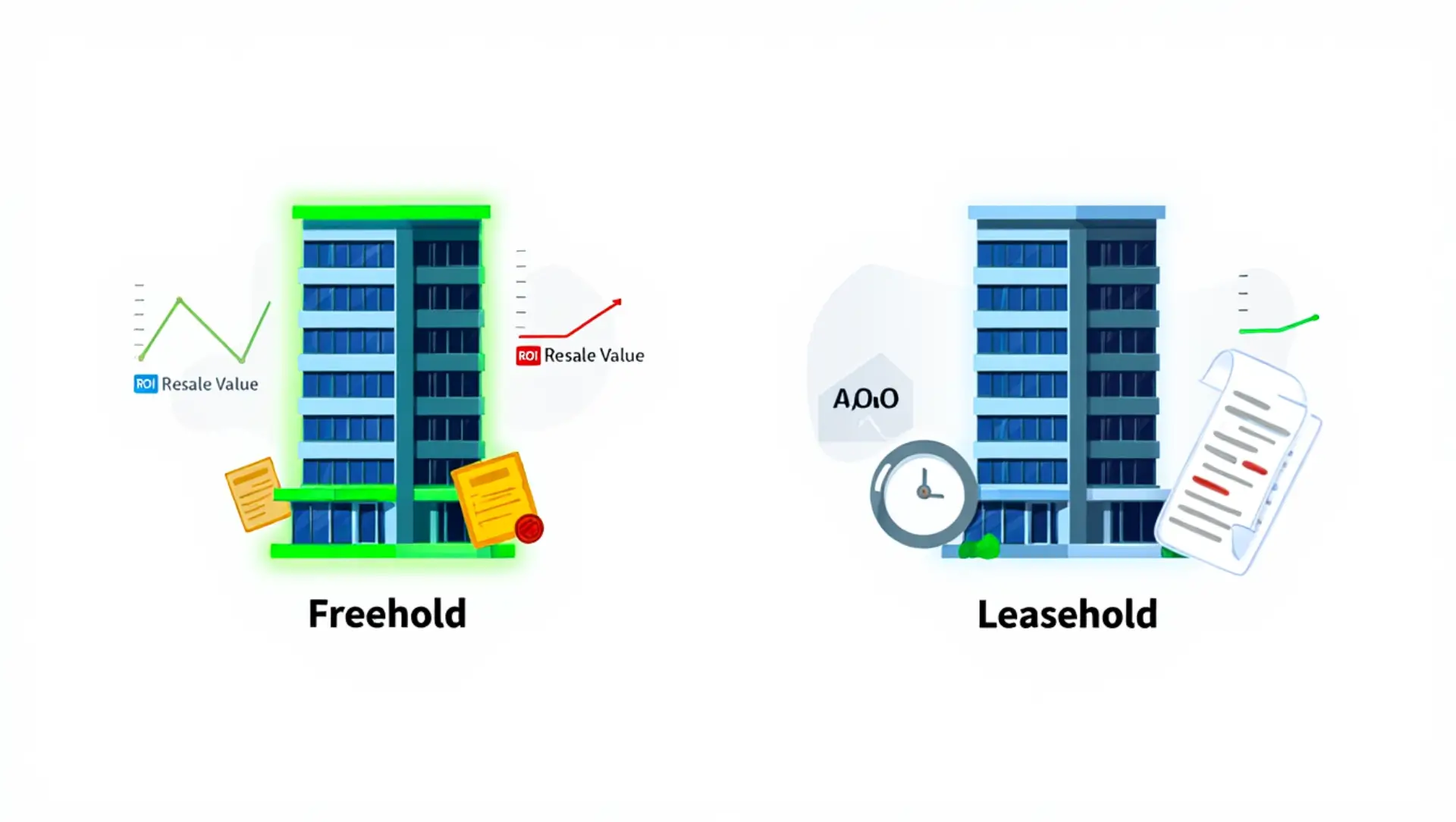
The choice between freehold and leasehold profoundly impacts your investment strategy, returns, and exit options. This decision should be driven by your specific investment goals rather than simply chasing the lowest purchase price.
Appreciation potential consistently favors freehold properties. Dubai Land Department data shows freehold properties in prime areas appreciated 12-18% more than comparable leasehold options over the past five years. This differential becomes particularly pronounced during market upswings. During Dubai’s 2021-2022 property boom, freehold apartments in Dubai Marina saw average appreciation of 38%, while similar leasehold units increased by only 23%.
Financing options also differ significantly. Banks typically offer more favorable mortgage terms for freehold properties, with higher loan-to-value ratios (up to 80% for expatriates and 85% for UAE nationals) and longer repayment periods. Leasehold properties face stricter lending criteria, with many banks reluctant to offer mortgages extending beyond 50-60% of the remaining lease term. This financing advantage directly impacts investor returns through leverage opportunities.
The resale market liquidity presents another crucial distinction. Freehold properties typically sell 30-40% faster than comparable leasehold units. I recently listed two similar 2-bedroom apartments in JBR – one freehold and one leasehold with 65 years remaining. The freehold unit received four offers within two weeks and sold at 97% of asking price. The leasehold property took nearly three months to sell and achieved only 91% of the initial asking price.
Rental yields present an interesting counterpoint to the appreciation advantage. Leasehold properties, with their lower acquisition costs, often generate higher initial rental yields – sometimes 1-2% above comparable freehold units. This creates an investment dichotomy: freehold for long-term capital appreciation versus leasehold for maximized short-term cash flow. Your investment horizon should guide this decision; investors looking at 5+ year horizons typically benefit more from freehold ownership despite the higher entry cost.
The inheritance implications also warrant serious consideration, especially for foreign investors. Dubai has progressively modernized its inheritance laws for non-Muslim property owners, but the process remains more straightforward for freehold properties. The Dubai International Financial Centre (DIFC) Wills Service allows non-Muslim owners of freehold property to register a will ensuring their assets are distributed according to their wishes rather than Sharia principles. This provides crucial peace of mind for international investors concerned about estate planning.
Understanding Dubai’s freehold property market requires cutting through significant confusion and misinformation. The distinctions between freehold and leasehold ownership, geographical restrictions on foreign purchases, legal rights and limitations, purchasing complexities, and investment implications create a multifaceted decision matrix for potential investors. By clearly understanding these factors, you can make informed decisions aligned with your investment goals, timeline, and risk tolerance.
The Dubai freehold property market continues to mature and evolve, presenting compelling opportunities for informed investors. Whether you’re seeking capital appreciation, rental income, or a combination of both, the key lies in understanding the nuanced ownership structures that make Dubai’s real estate market unique in the region and the world.


