A Complete Guide to Property Types in the UAE: From Apartments to Commercial Spaces
Last Updated on January 15, 2026
- 1. Quick Taxonomy: The Main Property Categories in the UAE
- 2. Residential vs. Commercial Properties: Understanding the Core Difference
- 3. Residential Property Types in the UAE
- 4. Commercial Property Types in the UAE
- 5. Niche & Specialized Property Types
- 6. Understanding Property Ownership in the UAE: Freehold vs. Leasehold
- 7. Regulations & Fees by Emirate: A Comparative Overview
- 8. Key Considerations: Off-Plan vs. Ready Properties
- 9. Practical Tools for Investors
- 10. NOI & Net Yield Calculator
- 11. Comparative Tables: UAE Property Types at a Glance
- 12. How to Invest in UAE Properties: Income, Appreciation, and Management
- 13. The Process Explained: Buying, Selling, and Renting Property
- 14. FAQ: UAE Property Types
- 15. Glossary of Key Terms
Quick Taxonomy: The Main Property Categories in the UAE
Navigating the UAE real estate market for the first time? It can feel like stepping into a parallel universe. Freehold, off-plan, serviced apartments, shell & core offices. The terminology alone is enough to make your head spin.
Here’s the thing, though.
Understanding these different property types isn’t just helpful—it’s the foundation of any successful investment or relocation. Without it, you’re essentially flying blind. This guide is my attempt to build you a clear, practical map of the UAE’s real estate landscape. We’ll cut through the jargon, break down the core residential and commercial formats, and explore what they’re actually for, how you can own them, and what kind of investment they represent.
Whether your goal is rental income or long-term appreciation, by the end you’ll have a solid understanding of the apartments, villas, offices, and even warehouses available—along with their potential returns and risks.
Quick Overview: What to Choose?
- For Stable Rental Income: Apartments in high-demand areas or small multi-unit buildings.
- For Family Living & Lifestyle: Villas or townhouses in master-planned communities.
- For Passive, Hands-Off Investment: Serviced apartments or a stake in a commercial property managed by a professional firm.
- For High Growth Potential: Off-plan properties from reputable developers or plots of land in emerging areas.
- For Business Operations: Fitted offices for quick setup or shell & core for custom layouts; warehouses for logistics.
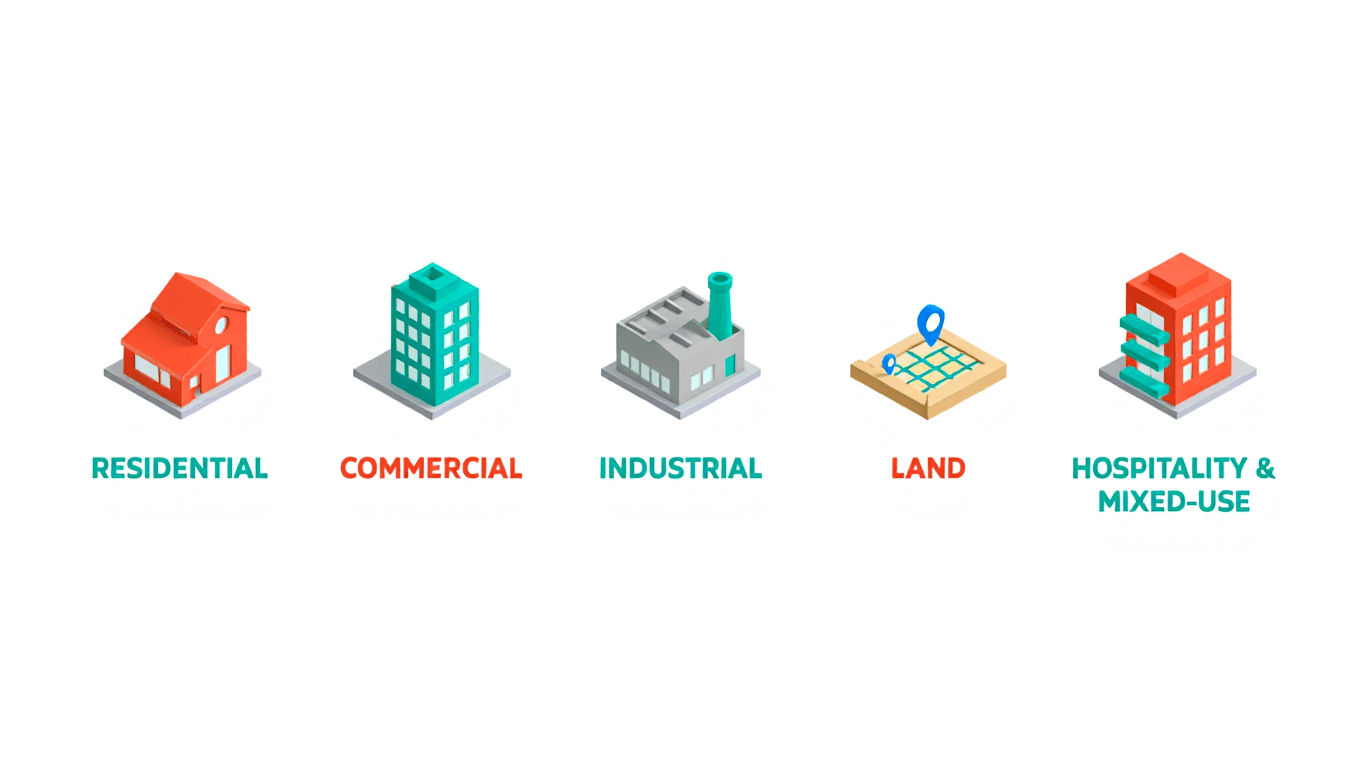
In the UAE, properties are broadly categorized into five main types, encompassing over 15 distinct subtypes:
- Residential: Properties for living (e.g., apartments, villas).
- Commercial: Properties for business (e.g., offices, retail shops).
- Industrial: Properties for manufacturing and logistics (e.g., warehouses, factories).
- Land: Undeveloped plots for future construction.
- Hospitality & Mixed-Use: Properties combining multiple functions (e.g., hotels, projects with retail and residential components).

“Over my 7+ years in the Dubai real estate market, I’ve seen countless investors—both new and experienced—get tangled in the sheer variety of properties available. The biggest mistake is choosing a property type that doesn’t align with your actual goal, whether it’s steady cash flow, quick appreciation, or a future family home. This guide is my attempt to build a clear, practical map. My goal is to help you distinguish between the options so you can invest with confidence, not confusion.”
Residential vs. Commercial Properties: Understanding the Core Difference
The most fundamental split in real estate is between residential and commercial properties. Simply put, residential properties are designed for people to live in, while commercial properties are used for business activities to generate income.
This distinction is everything.
It dictates the investment logic, the rules you must follow, and the potential returns. Understanding this core difference helps you evaluate profitability, risks, and management requirements more accurately. Are you looking for a home or a cash-generating asset? The answer determines which path you take.
Disclaimer: This information is for general guidance and does not constitute legal or financial advice. Investment decisions and legal interpretations require consultation with a qualified professional.
- Purpose: Living vs. earning.
- Zoning: Regulations strictly separate residential and commercial zones.
- Income Source: Rental payments from individuals or families versus lease agreements with businesses.
- Lease Terms: Residential leases are typically short-term (one year), while commercial leases are often multi-year, providing more stability. This is a common market practice, though specific terms are always subject to negotiation and contractual agreement.
- Primary Goal
- Residential: Housing for individuals/families. Commercial: Space for businesses to operate and generate profit.
- Income Source
- Residential: Monthly rent from tenants. Commercial: Long-term lease payments from corporate tenants.
- Key Risks
- Residential: Tenant turnover, vacancy periods, property damage. Commercial: Economic downturns affecting businesses, longer vacancy if a major tenant leaves.
- Typical Zoning
- Residential: Designated residential areas, often with community amenities. Commercial: Central business districts, free zones, retail hubs.
For detailed information on zoning and land use, investors should consult the official guidelines from the Dubai Land Department (dubailand.gov.ae) and the Abu Dhabi Department of Municipalities and Transport.
Residential Property Types in the UAE
Residential properties are the most common entry point for investors in the UAE. The market is diverse, catering to everyone from single professionals to large families. Let’s break it down.
Residential Property Type 1: Apartments
Apartments are the most popular and liquid residential format in the UAE, located in multi-story buildings and perfect for both buying and rental strategies. They are an excellent choice for investors seeking stable rental income, especially in high-demand locations like Business Bay or Dubai Marina.
When considering an apartment, the key factors are always location, access to transport, building amenities, and the reputation of the real estate management company.
- Types: The range is vast, from compact studios and standard 1, 2, or 3-bedroom units to spacious duplexes, lofts, and ultra-luxury penthouses.
- For Investment: High rental demand is concentrated in business hubs and tourist-heavy areas. Market data from Q1 2025 showed gross rental yields for apartments averaging around 7.3%, according to reports from Property Finder.
- Amenities: Modern buildings compete on amenities, often including swimming pools, gyms, concierge services, and dedicated parking.
- Location: Proximity to metro stations, schools, and major business districts is critical for value and rentability.
- Risks: Be mindful of annual service charges, which can impact your net income, and potential competition from new projects in the area.
| Apartment Type | Typical Area (sq. ft.) | Average Gross Rental Yield (2025)* | Common Amenities | Best For |
|---|---|---|---|---|
| Studio | 350 – 600 | 7.5% – 9.0% | Pool, Gym, Security | Single professionals, short-term rentals |
| 1-Bedroom | 700 – 1,100 | 7.0% – 8.5% | Pool, Gym, Parking, Concierge | Young couples, executives |
| 2-Bedroom | 1,200 – 1,800 | 6.5% – 7.5% | Family pool, Kids’ play area, Gym | Small families, sharers |
| 3-Bedroom | 1,800 – 3,000+ | 5.5% – 6.5% | Multiple pools, Parks, Security | Larger families |
| Penthouse | 3,000 – 10,000+ | 4.0% – 5.5% | Private pool, Terrace, Valet | High-net-worth individuals |
Note: Yields are indicative and based on market analysis from Q1 2025 reports. Always conduct your own due diligence.
Residential Property Type 2: Villas and Townhouses
Villas and townhouses are residential properties designed for family life, emphasizing space, privacy, and often a private garden or yard. These are typically purchased for personal use or as long-term holdings for rental to families in master-planned communities with exclusive amenities.
When buying or selling, it’s crucial to assess community rules, location relative to business districts, construction quality, and annual service fees. Both ready and off-plan options are available for purchase. Communities like Arabian Ranches or Jumeirah Islands are prime examples.
- Villas: Can be fully detached or semi-detached (sharing one wall), situated on larger plots of land.
- Townhouses: Rows of homes connected by side walls, offering a balance between the space of a villa and a more accessible budget.
- Private Amenities: A key draw is the private outdoor space, terrace, and dedicated parking. Many communities also feature a residents-only clubhouse.
- Community: These developments are often self-contained worlds with schools, parks, retail outlets, and 24/7 security.
- Location: Commute time to major business hubs is a decisive factor for many tenants and buyers.
“Families relocating to the UAE often prioritize community and space. A townhouse or villa in a well-serviced community becomes more than a house; it’s an entire lifestyle. For an investor, this means a more stable, long-term tenant base, as families tend to sign longer leases and renew more frequently than transient professionals.”
- Villa
- Structure: Fully detached or semi-detached. Privacy: High, with private land on all sides. Plot Size: Larger. Cost & Maintenance: Higher initial cost and ongoing maintenance (CAPEX). Best For: Larger families seeking maximum space and privacy.
- Townhouse
- Structure: Part of a row, sharing one or two walls. Privacy: Moderate, with a private entrance and often a small yard. Plot Size: Smaller. Cost & Maintenance: More affordable, with potentially shared community maintenance costs. Best For: Families and couples wanting more space than an apartment on a more accessible budget.
Other Residential Formats: Serviced Apartments, Branded Residences, and More
Beyond the standard options, the UAE offers several niche residential types. These cater to specific investor profiles and lifestyle preferences.
- Serviced & Hotel Apartments: These are fully furnished apartments offering hotel-style services like cleaning, laundry, and concierge. They are ideal for passive investors and frequent travelers, providing a turnkey management solution and high liquidity for short-term and long-term rentals.
- Branded Residences: These are luxury apartments or villas associated with a premium brand, such as a high-end hotel (e.g., The Ritz-Carlton, Four Seasons) or a fashion label. They offer exclusive services, superior quality, and a mark of prestige that often commands a premium price and higher rental rates.
- Duplex/Triplex: These are apartments spread over two or three floors within a single building, offering a house-like feel with distinct living and sleeping zones. They combine the spaciousness of a villa with the convenience and amenities of apartment living.
- Penthouses: Situated on the top floor(s) of a luxury building, penthouses are the pinnacle of apartment living. They are prized for their expansive layouts, panoramic views, high-end finishes, and exclusive features like private terraces or pools.
Commercial Property Types in the UAE
Commercial properties are purely investment assets, designed to generate income through leases to businesses. The dynamics here are very different from the residential market, focusing on long-term stability and corporate tenant quality.
Exploring commercial real estate in Dubai reveals a landscape of diverse opportunities.
Commercial Property Type 1: Office Spaces
Office spaces are commercial properties within dedicated office buildings, providing rental income from corporate clients through long-term lease agreements. Their investment appeal lies in stable, predictable rental income and lower tenant turnover, provided the business location is prime.
Offices come in two main conditions:
- Shell & Core: An empty shell with just the basic structure, allowing the tenant to design and fit out the space to their exact specifications.
- Fitted/Managed: Ready-to-move-in offices, sometimes fully furnished and managed.
Key factors for an office investment are the building’s grade (A, B, C), parking availability, proximity to public transport, and the flexibility of the floor plan. Areas like Business Bay and DIFC are particularly attractive for office investments.
| Feature | Shell & Core Office | Fitted Office |
|---|---|---|
| Initial CAPEX for Landlord | Low | High |
| Time to Lease | Longer (tenant needs time for fit-out) | Shorter (ready for immediate occupancy) |
| Rental Rate | Lower | Higher |
| Target Audience | Large corporations with specific needs | SMEs, startups, companies needing flexibility |
Commercial Property Type 2: Retail Units
For retail properties in commercial real estate—like shops and showrooms—location is everything. The retail market in Dubai is heavily influenced by foot traffic, visibility, parking access, and the presence of nearby “anchor” tenants (like a major supermarket or brand) which determine success.
Income is generated from a lease, which often includes a base rent plus a percentage of the tenant’s revenue. Investment opportunities vary by market segment: high-street retail, units within shopping malls, or local community centers.
The risks include high tenant turnover and sensitivity to economic cycles, but a well-located retail unit can provide excellent income and significant capital appreciation. Key retail clusters in the UAE include The Dubai Mall, Mall of the Emirates, City Walk, and Yas Mall in Abu Dhabi, each attracting millions of visitors annually.
Commercial Property Type 3: Industrial, Warehouses, and Land
Industrial assets, including warehouses and other commercial buildings, serve the logistics, storage, and light manufacturing sectors. Land itself can be an investment, either held for appreciation or for future development.
For these properties, zoning regulations, access to transport corridors (like ports and airports), and proximity to free zones are critical. Driven by the growth of e-commerce and the evolution of logistics and supply chain infrastructure, this real estate category offers stable income from long-term leases and strong potential for capital appreciation.
However, it requires specialized due diligence regarding land permits, utility access, and infrastructure.
“While everyone is watching the glamorous apartment towers, savvy investors are looking at warehouses. The rise of e-commerce has created unstoppable demand. The long-term leases and stable demand from logistics companies create a very predictable, low-maintenance income stream. It’s not flashy, but it’s incredibly effective.”
- Zoning & Permitting: Verify that the land is zoned for industrial use and all necessary permits are obtainable.
- Infrastructure Access: Assess connectivity to major highways, ports (e.g., Jebel Ali), and airports.
- Utility Capacity: Confirm access to sufficient power, water, and telecommunications infrastructure.
- Site Suitability: Evaluate soil conditions, topography, and environmental regulations.
- Lease & Tenant Analysis: For existing properties, review current lease terms, tenant creditworthiness, and market rental rates.
Niche & Specialized Property Types
Niche Commercial & Industrial
- Co-living & Staff Accommodation: Purpose-built residential blocks leased by companies to house their employees. These offer stable, long-term rental income backed by corporate guarantees.
- Build-to-Rent (BTR): Entire residential buildings owned by a single entity and designed specifically for the rental market, offering professional management and consistent branding.
- Cold Storage & Last-Mile Warehouses: Specialized industrial assets catering to the grocery/pharma sectors (cold chain) and rapid e-commerce delivery (last-mile). These command premium rents due to their specific infrastructure.
Specialized Land Rights
- Musataha (Abu Dhabi): A real property right granting the holder the ability to construct a building or invest in a plot of land owned by another party for a specified period (up to 50 years, renewable), allowing the holder to own the constructed assets.
- Long-Term Lease (Abu Dhabi): Similar to leasehold, offering rights for up to 99 years, but may have different terms regarding development and usage, particularly in industrial and commercial zones.
Hospitality & Mixed-Use
This category includes hotels, hotel apartments, and mixed-use developments that combine residential, office, and retail spaces in a single project. These are complex assets but offer diversified income streams, which can provide stability against downturns in any single sector.
| Income Stream in Mixed-Use Project | Typical Share of Revenue* | Seasonality | Key Risks |
|---|---|---|---|
| Residential Rental | 40-50% | Low | Vacancy, service charge disputes |
| Office Leases | 30-40% | Very Low | Economic downturn, corporate relocations |
| Retail Leases | 15-25% | Medium | Low footfall, tenant turnover |
| Hospitality/Hotel | Varies | High | Tourism fluctuations, competition |
Note: These figures are illustrative and vary based on project specifics and market conditions. Source: Industry benchmarks, 2025.
Understanding Property Ownership in the UAE: Freehold vs. Leasehold
When considering a freehold property in Dubai, it’s vital to understand the legal framework. Property ownership rules in the UAE are determined by each emirate and specific designated zones.
Foreign investors will encounter two main models: freehold and leasehold. Each has distinct regulations and is recorded differently in the land registry.
| Parameter | Freehold | Leasehold |
|---|---|---|
| Ownership Term | Indefinite (in perpetuity) | Fixed term, typically up to 99 years (a 99-year lease) |
| Owner’s Rights | Full rights to the land and structure; can sell, lease, or inherit | Right to use the property for the lease term; no ownership of the land |
| Inheritance | Yes, can be passed down according to UAE law or a will | The right to use is transferable for the remainder of the lease term |
| Best For | Long-term investors and end-users seeking full control | Investors optimizing their entry budget or focusing on specific locations |
In short: Freehold is the choice for complete control and legacy planning. Leasehold lowers the barrier to entry and can be advantageous in certain prime areas where freehold is unavailable.
Before any property purchase, always verify the specific regulations of the emirate and the terms in the land registry to ensure the ownership model aligns with your investment goals.
Commonhold
This applies to multi-unit buildings. Owners of individual units (like apartments) also co-own a share of the common areas (lobbies, pools, etc.). They pay service charges for maintenance and participate in the building’s management through an owners’ association.
Usufruct
This is a long-term right to use and benefit from a property without owning the land itself. It’s similar to a leasehold but can have different terms and is often used in specific zones or for certain projects.
For official regulations, refer to the Dubai Land Department (DLD), Abu Dhabi Department of Municipalities and Transport (DMT), and the Real Estate Regulatory Agency (RERA).
Regulations & Fees by Emirate: A Comparative Overview
Navigating the administrative side of property transactions requires understanding the specific rules of each emirate. Registration systems and fees differ, impacting the total cost of acquisition and leasing.
| Regulation / Fee | Dubai | Abu Dhabi | Sharjah |
|---|---|---|---|
| Property Transfer Fee | 4% of property value (paid to DLD) | 2% of property value (paid to DMT) | 4% of property value (paid to SRERD) |
| Lease Registration System | Ejari: Mandatory for all rental contracts. | Tawtheeq: Mandatory for all rental contracts. | Tasdeeq: Mandatory for all rental contracts. |
| Lease Registration Fee | Approx. AED 220 | 5% of annual rent (for first year), 1% for subsequent years | 4% of annual rent |
| Key Regulator | Dubai Land Department (DLD) & RERA | Department of Municipalities and Transport (DMT) | Sharjah Real Estate Registration Department (SRERD) |
Note: Fees are subject to change. Always verify with the respective government authority before a transaction.
Key Considerations: Off-Plan vs. Ready Properties
Another major decision for investors is whether to buy a property that is still under construction (off-plan) or one that is already built (ready). Investing in off-plan properties can be a powerful strategy for capital appreciation.
- Off-plan: Offers a lower entry price, attractive payment plans, and the potential for significant capital appreciation by the time of completion. However, it carries risks of construction delays and market changes.
- Ready: Allows you to generate rental income from day one and what you see is what you get. The downside is a higher initial capital outlay and potential costs for renovation or furnishing.
Before committing, always check the developer’s track record, ensure the project has a registered escrow account with RERA, and analyze the rental rates and service charges in the surrounding area.
| Factor | Off-Plan Property | Ready Property |
|---|---|---|
| Entry Price | Lower | Higher |
| Risk Level | Higher (delays, market shifts) | Lower (tangible asset) |
| Liquidity | Lower until completion | Higher |
| Income Generation | Delayed until handover | Immediate |
Practical Tools for Investors
Calculating Your Potential Return (NOI & Net Yield)
To assess an investment, you must look beyond gross yield. Net Operating Income (NOI) is a crucial metric.
Formula: NOI = Gross Annual Rent - Vacancy Loss - Operating Expenses
Net Yield Formula: Net Yield = (NOI / Total Property Cost) * 100
Example Calculation:
- Purchase Price: AED 1,000,000
- Gross Annual Rent: AED 80,000
- Vacancy (5%): -AED 4,000
- Operating Expenses (Service Charges, Maintenance): -AED 15,000
- NOI = 80,000 – 4,000 – 15,000 = AED 61,000
- Net Yield = (61,000 / 1,000,000) * 100 = 6.1%
Micro Case Studies (2025 Market Data)
Case 1: 1-Bedroom Apartment in JVC, Dubai
- Purchase Price: AED 850,000
- Annual Rent: AED 75,000
- Service Charges: AED 12,000
- Net Yield: Approx. 7.4% (before financing costs)
- Commentary: High demand from young professionals ensures low vacancy, making it a strong income-generating asset. For more on this area, see properties in Jumeirah Village Circle.
Case 2: 3-Bedroom Villa in Arabian Ranches
- Purchase Price: AED 3,500,000
- Annual Rent: AED 200,000
- Service Charges: AED 25,000
- Net Yield: Approx. 5.0%
- Commentary: Lower yield but strong potential for capital appreciation and attracts stable, long-term family tenants.
Case 3: Small Warehouse in Dubai Industrial City
- Purchase Price: AED 2,000,000
- Annual Rent: AED 180,000
- Operating Expenses: AED 20,000
- Net Yield: Approx. 8.0%
- Commentary: Leased on a 3-5 year term to a logistics company, providing a highly stable, low-maintenance income stream.
(Source: Anika Property internal market data, 2025. Figures are for illustrative purposes.)
NOI & Net Yield Calculator
Comparative Tables: UAE Property Types at a Glance
To simplify, here are two summary tables to help you compare your options quickly.
Residential Property: Type, Pros, Cons, Best For
| Type | Pros | Cons | Best For |
|---|---|---|---|
| Apartments | High liquidity, prime locations, amenities | Service charges, high competition | Investors, young professionals, couples |
| Villas | Space, privacy, land ownership | Higher cost and maintenance | Families, long-term residents |
| Townhouses | Balance of budget and space | Less privacy than a villa | Families on a mid-range budget |
| Serviced/Hotel Apt | Turnkey management, high liquidity | Higher fees, potentially lower net ROI | Passive investors, frequent travelers, expats |
Commercial and Industrial: Yield and Risk
| Type | Potential Yield | Risk Level | Commentary |
|---|---|---|---|
| Offices | Medium/High | Medium | Location quality and building grade are key. |
| Retail | High (in top locations) | Elevated | Highly dependent on foot traffic and tenant quality. |
| Warehouses/Industrial | Stable | Low/Medium | Driven by logistics and long-term contracts. |
| Land | Depends on project | Medium to High | Requires expertise; zoning is a major factor. |
How to Invest in UAE Properties: Income, Appreciation, and Management
Ultimately, real estate investment in the UAE is driven by two strategies: generating rental income for consistent cash flow or achieving capital appreciation through rising property values.
The smartest investors in the real estate market often build a diversified portfolio by buying and selling different types of assets across various clusters. For insights on top areas to invest in Dubai, our dedicated guide can help.
- Rental Income: Focus on high-demand locations, screen for quality tenants, calculate your Net Operating Income (NOI) carefully, and keep a close eye on service charges.
- Capital Appreciation: Invest in up-and-coming neighborhoods or off-plan projects, but only after thoroughly analyzing future supply and infrastructure plans.
- Property Management: For overseas investors, this is non-negotiable. Professional Property Management increases occupancy rates, reduces vacancies, and handles all contracts and inspections. A service like our Property Care 360° ensures your asset is performing without you needing to be in the country.
- Risks: Market cycles, interest rate changes, and new regulations are always a factor. Diversification is your best hedge.
“In 2025, we’re seeing gross rental yields of 7-9% for apartments in areas like JVC and Business Bay, while villas in established communities like Arabian Ranches are yielding around 5-6%. The key is balancing yield with potential for capital growth.”
The Process Explained: Buying, Selling, and Renting Property
So, what are the different types of processes involved? Each transaction has a clear sequence of steps. Let me walk you through them.
Buying Property: Key Purchase Steps
A typical property purchase involves selecting the property, getting pre-approved for financing, making an offer, signing a Memorandum of Understanding (MoU), conducting due diligence (legal checks, service charge history), paying a deposit, obtaining a No Objection Certificate (NOC) from the developer, preparing contracts, and finally, transferring the title at the DLD/ADREC and paying the associated fees.
Using an agency and a lawyer makes the real estate transaction faster and safer. For a detailed walkthrough, check out our guide on buying property in Dubai.
Selling Property: Steps for the Seller
Selling a property starts with a market valuation and marketing strategy. It involves preparing the property (staging, minor repairs), appointing agents, listing it with professional photos, conducting viewings, negotiating offers, signing an MoU, clearing any existing mortgage, preparing contracts, and completing the transfer.
Managing the timeline and paperwork is crucial for a smooth real estate transaction. Our article on how to sell your Dubai property provides comprehensive insights.
Renting Property: Rental Process and Lease Agreement
The rental process includes preparing the unit, setting a competitive rent, listing and showing the property, screening tenants, agreeing on terms, signing a lease agreement, collecting security deposits and post-dated cheques, and registering the lease (e.g., Ejari in Dubai).
A clear contract and a move-in inspection report protect both the landlord and the tenant.
FAQ: UAE Property Types
What is the difference between a villa and a townhouse in the UAE?
A villa is a standalone house on a larger plot of land, offering maximum privacy. A townhouse is part of a row of houses connected by shared walls, typically with a smaller private yard and a more accessible budget.
Can a foreigner own any type of property in Dubai?
Yes, in designated “freehold” zones, foreigners can have full ownership. In other areas, ownership is restricted to leasehold or usufruct models according to specific regulations. For more details, read our article on foreigners investing in Dubai real estate.
What is the most popular property type for investment?
Apartments in liquid, high-demand locations remain the most popular choice for rental income. Recently, warehouses have also seen a surge in demand from investors due to the growth of logistics.
What is “off-plan” and what property type does it apply to?
“Off-plan” refers to buying a property directly from a developer before it’s built. It can apply to any property type—residential or commercial—depending on the project.
Are serviced apartments a good investment?
Yes, they can be, especially in a strong location with a reputable operator. They offer a hands-off investment model. However, you must carefully analyze the service fees and revenue-sharing structure to understand your true net income.
For more market data, see the latest quarterly reports from Knight Frank, JLL, and CBRE on the UAE real estate market.
Glossary of Key Terms
- Freehold
- Absolute ownership of the property and the land it stands on.
- Leasehold
- The right to use a property for a long, fixed term (e.g., 99 years), but without owning the land.
- Commonhold
- A system of ownership for multi-unit buildings where individuals own their unit and a share of the common areas.
- Usufruct
- The right to use and derive profit from a property owned by someone else.
- Musataha
- A right to build on and use a plot of land owned by another party for a defined period, common in Abu Dhabi.
- Shell & Core
- A property (usually an office) handed over as a bare structural shell, ready for the tenant’s custom fit-out.
- Fitted
- A property that is already finished with flooring, ceilings, and basic electrical/plumbing, ready for occupancy.
- NOI (Net Operating Income)
- A property’s annual income after deducting all operating expenses but before deducting taxes and financing costs.
- BTR (Build-to-Rent)
- Residential properties built specifically for long-term rental rather than for sale.

Meet Our Property Specialists
Ready to explore your options? Our team of experienced realtors is here to guide you through every type of property the UAE has to offer.
 Laura LavinskyRealtor
 Mike GriffinRealtor
 Zoe HernandezRealtor
 Tim FernandezRealtor
 Sayan KashaniRealtor
 Tina DeviRealtor